ASP.NET Core | Request pipeline or middleware pipeline
The ASP.NET Core request pipeline consists of a sequence of request delegates, called one after the other. The following diagram demonstrates the concept. The thread of execution follows the black arrows.
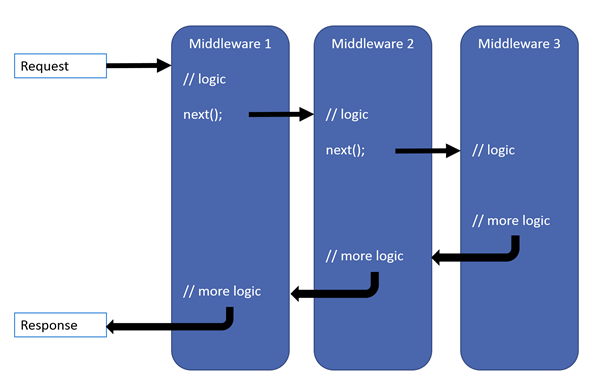
Each delegate can perform operations before and after the next delegate. Exception-handling delegates should be called early in the pipeline, so they can catch exceptions that occur in later stages of the pipeline.
The simplest possible ASP.NET Core app sets up a single request delegate that handles all requests. This case doesn't include an actual request pipeline. Instead, a single anonymous function is called in response to every HTTP request.
var builder = WebApplication.CreateBuilder(args);
var app = builder.Build();

app.Run(async context =>
{
    await context.Response.WriteAsync("Hello world!");
});

app.Run();
Chain multiple request delegates together with Use. The next parameter represents the next delegate in the pipeline. You can short-circuit the pipeline by not calling the next parameter. You can typically perform actions both before and after the next delegate, as the following example demonstrates:
var builder = WebApplication.CreateBuilder(args);
var app = builder.Build();

app.Use(async (context, next) =>
{
    // Do work that can write to the Response.
    await next.Invoke();
    // Do logging or other work that doesn't write to the Response.
});

app.Run(async context =>
{
    await context.Response.WriteAsync("Hello from 2nd delegate.");
});

app.Run();
Comments
Post a Comment